Last updated: October 12, 2025
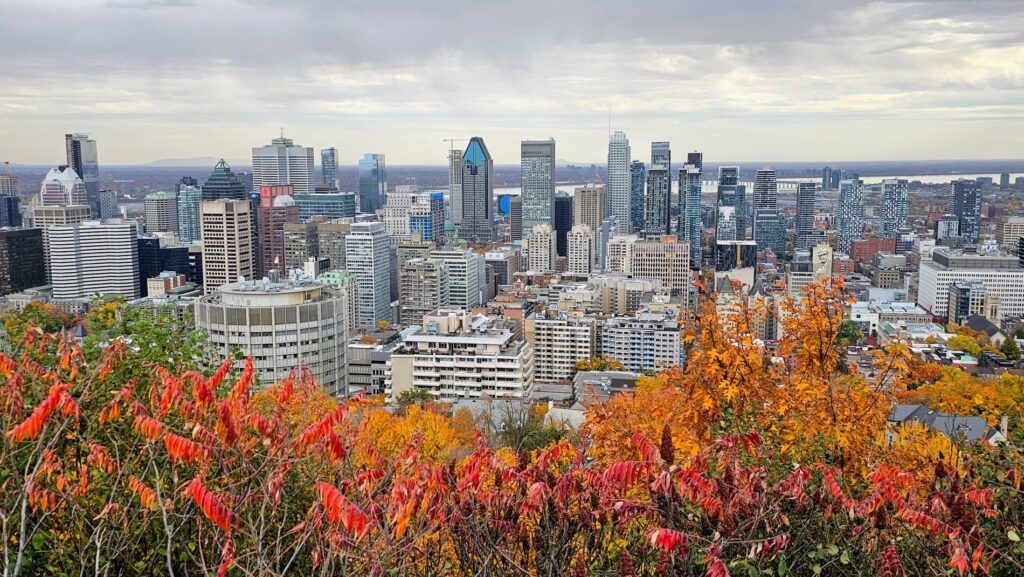
When October hits Montréal, something magical happens. The air gets crisp. The light turns golden. And just about every maple tree in the city seems to catch fire. But you don’t need a car—or a mountain trek—to enjoy it. Some of the most stunning Montreal fall colours walks are just a métro ride away. Whether you’re here for a few days or live here year-round, these easy walks will take you straight into the colour, the crunch of leaves underfoot, and that fleeting autumn mood that makes Montréal unforgettable this time of year.
Quick take
- Peak colour in the city usually lands in early to mid-October, lingering in sheltered parks.
- All routes are car-free and start near métro or frequent bus lines.
- Each loop runs 60–120 minutes with a warm drink stop nearby.
- Prefer a guide? Join our 2-hour Old Montréal small-group tour (max 10).
Best Montréal fall-colour walks
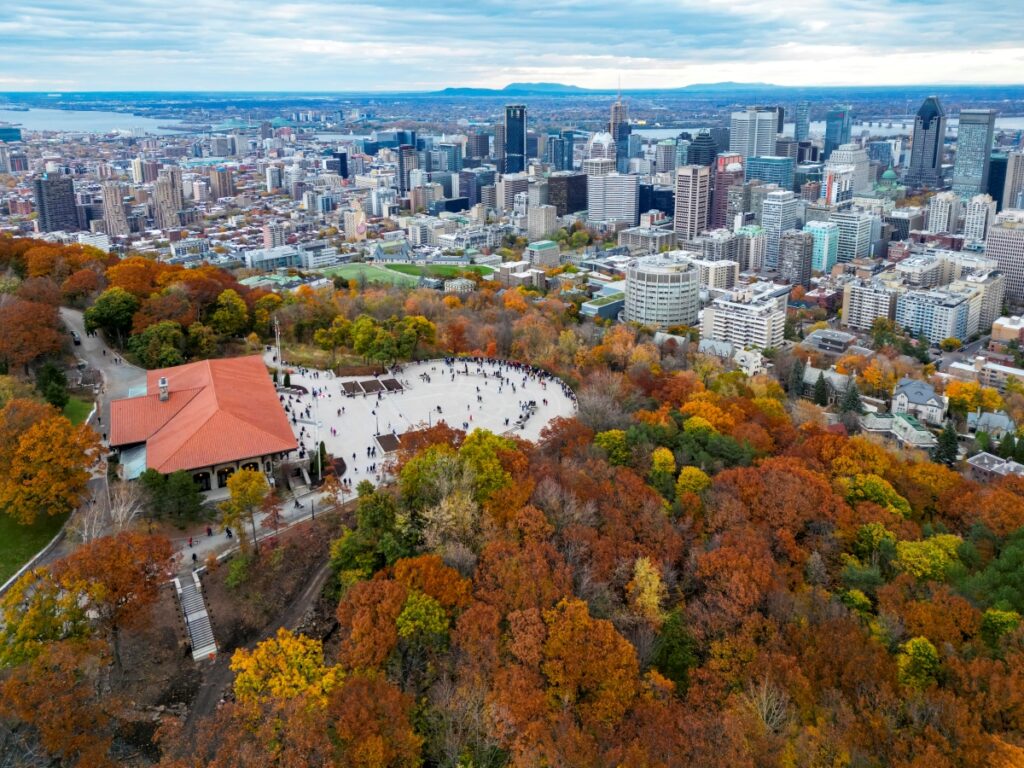
1) Mount Royal Classic: Belvedere Kondiaronk → Beaver Lake (90–120 min)
Start: Métro Peel (Green line) — Walk uphill 10–12 minutes on Peel Street to the staircase.
Alternate: Métro Mont‑Royal (Orange line) + Bus 11 “Parc du Mont‑Royal” to Maison Smith
Map: Belvedere Kondiaronk
Mount Royal is the city’s spiritual backbone. When Jacques Cartier first named it Mont-Royal in 1535, little did he know the mountain would become central to the island’s identity. Long before that, it was a place of gathering, ceremony, and travel for the Kanien’kehá:ka (Mohawk) and other Indigenous peoples, who moved through the area seasonally and regarded the mountain as a sacred presence on the island. Over the centuries, the slopes were used for grazing, military signaling posts, and even as burial grounds in Indigenous traditions. In the late 1800s, the city acquired large parcels for public green space; then in the 1870s, the city hired Frederick Law Olmsted to design its major parkways (he also co‑designed Central Park).
The Belvedere Kondiaronk is named after the Indigenous diplomat Kondiaronk who played a pivotal role in 17th‑century Iroquois–French diplomacy. Below, Beaver Lake was engineered in the 1930s, replacing a swampy area, and in earlier times the site was forest and wetlands used by local travellers. On a crisp October day, the skyline edge seems to float above the tree canopy—history and nature in perfect alignment.
2) Parc La Fontaine Maple Promenade (60–90 min)
Start: Métro Sherbrooke (Orange line) or Bus 24 / 29
Map: Parc La Fontaine
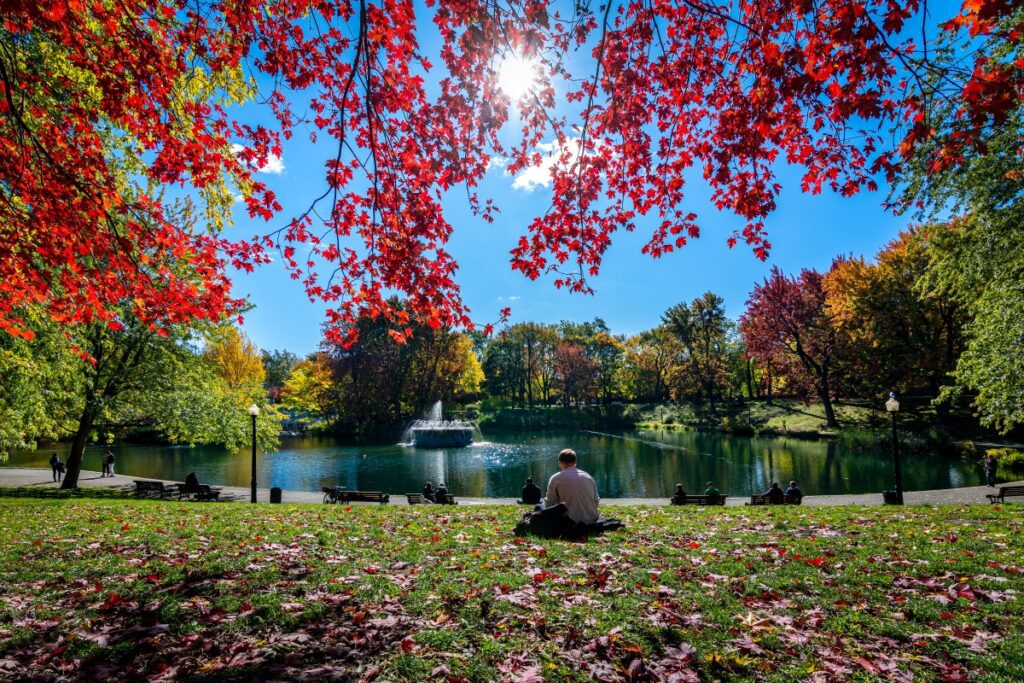
Parc La Fontaine’s land once included the prison farm—back when prisoners were expected to work the fields and raise livestock. In the 19th century, city planners converted it into a public park during Montréal’s expansion and beautification era. The park was officially inaugurated in the 1870s.
Louis-Hippolyte La Fontaine, the park’s namesake, was Canada’s first French Canadian Prime Minister (1848–1851) and a champion of responsible government. The Théâtre de Verdure, open-air stage built in the early 20th century, attracted jazz, poetry, and political rallies. The scenic pond bridges and footpaths were added later to unify the park’s two halves. As leaves deepen into flame, walking the reflection-lined paths feels like stepping into over a century of city life, art, and politics woven into every maple branch.
3) Lachine Canal: Atwater Market ↔ Old Port (60–120 min)
Start: Métro Lionel-Groulx (Green & Orange lines)
Map: Atwater Market/Lachine Canal
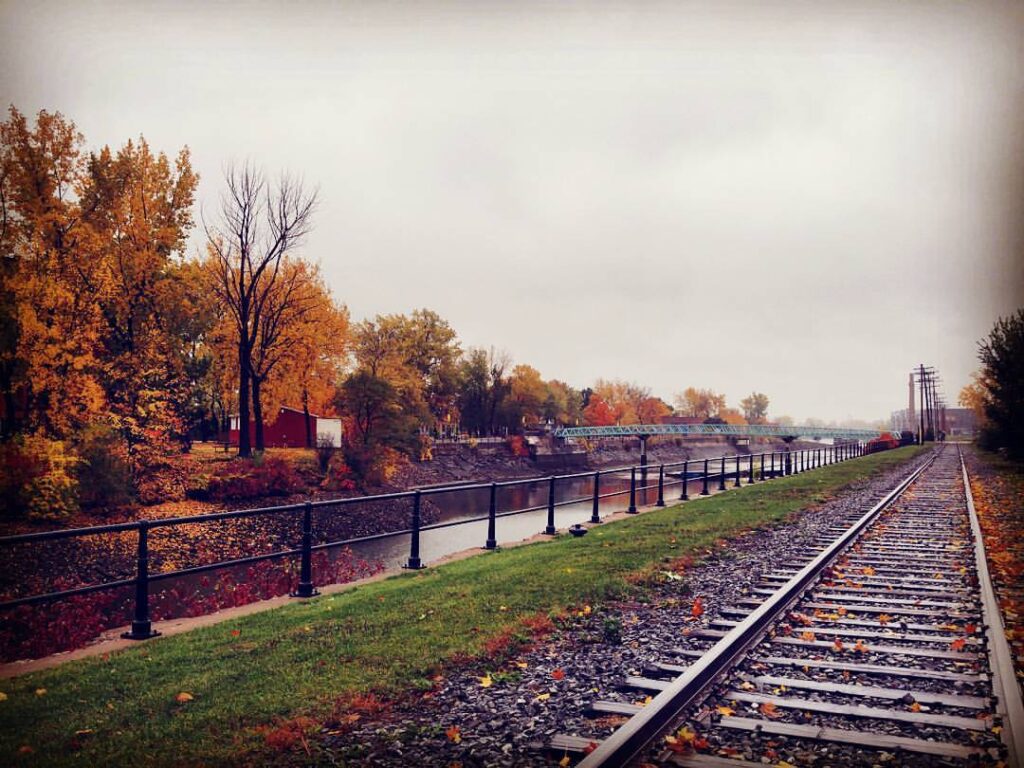
The Lachine Canal was a transformative feat of 19th-century engineering. Completed in 1825, it allowed ships to bypass dangerous rapids near Lachine, turning Montréal into a major inland port. Factories sprouted along its banks—textiles, machinery, grain mills—powering Canada’s industrial era. During the American Civil War, the canal’s warehouses were vital supply depots.
Over time, as rail and road supplanted canals, the corridor fell into decline. But since the late 20th century, it has been revitalized into a beloved linear park. As you walk beneath iron footbridges and golden trees, you’re literally walking past relics of Montréal’s economic boom—brick factories, loading docks, and canal locks now quieted by time and light. Atwater Market, perched right along the path, is especially charming in the fall. Stalls overflow with colourful harvest produce—crisp apples, heirloom squash, and piles of pumpkins—while the scent of fresh pastries drifts through the air. Just behind the market, a quiet footbridge offers one of the prettiest canal views in the city, framed by trees turning brilliant shades of gold and orange.
4) Parc Jean-Drapeau Riverside Colours (90 min loop)
Start: Métro Jean-Drapeau (Yellow line)
Map: Parc Jean-Drapeau
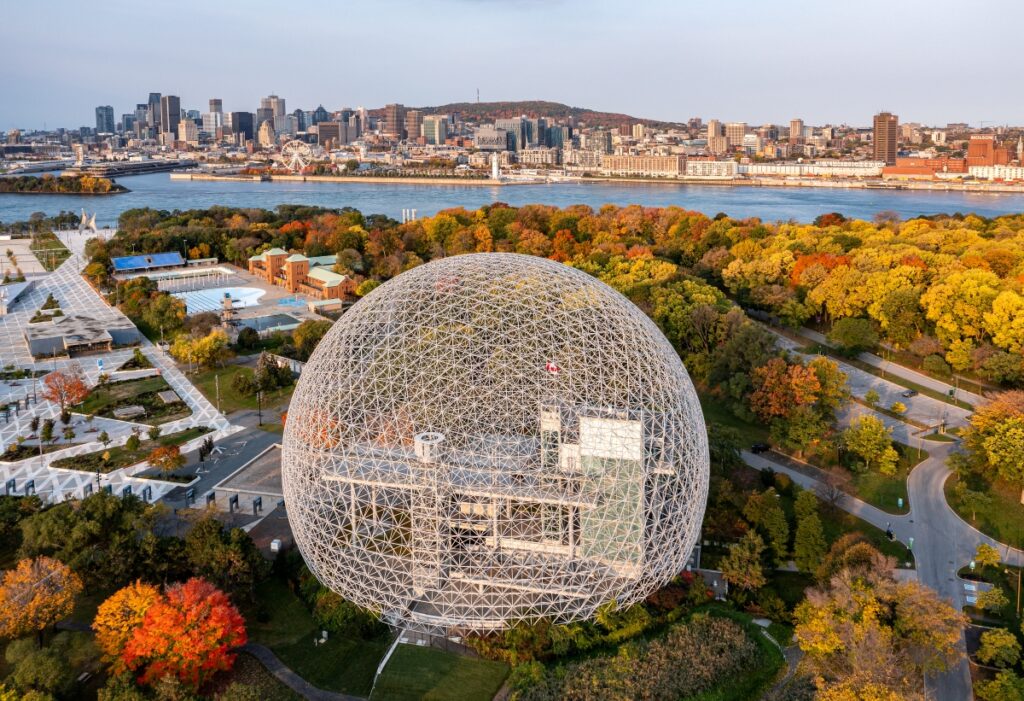
These islands have witnessed centuries of change. Originally used by Indigenous peoples, Fort Sainte-Hélène was constructed in the 1820s to defend Montréal from invasion. In the 19th century, the islands were partially used for fairs and military training grounds. But the major transformation came in 1967, when Expo 67 turned the space into a global showcase. The Biosphère, formerly the U.S. pavilion designed by Buckminster Fuller, remains an iconic structure.
Walking here in fall, you’ll cross land once trod by Jean Drapeau himself—Montreal’s long-serving mayor responsible for major urban development including the metro and Expo. Today, foliage drapes over modern pavilions, promenades trace paths once laid for visitors of world fairs, and the skyline rises behind an autumn curtain.
5) Montreal Botanical Garden & Parc Maisonneuve (60–90 min)
Start: Métro Pie-IX or Viau (Green line)
Map: Jardin botanique de Montréal
The Montréal Botanical Garden was inaugurated in 1931, conceived by Brother Marie-Victorin during the Great Depression as a project of civic pride and botanical research. It features themed gardens, a Chinese garden, Japanese garden, and arboretum, with over 700 tree species. In the evenings during fall, the space transforms into the magical Gardens of Light, where lanterns illuminate the pavilions and pathways in a glowing celebration of light, nature, and culture—especially stunning in the Chinese Garden.
Parc Maisonneuve, named after governor Paul de Chomedey de Maisonneuve, occupies what was once the city’s horse racing track (in the late 19th and early 20th centuries). Over time, the racetrack gave way to open greenspace, athletic fields, and promenades. In autumn, these two spaces—one curated and one freeform—blend. As leaves blaze, you walk through decades of horticulture, scientific ambition, and urban transformation.

6) Parc Nature Île-de-la-Visitation Nature Walk (90–120 min)
Start: Métro Henri-Bourassa (Orange line) + Bus 69 “Gouin”
Map: Île de la Visitation
This rocky riverside landscape in Parc Nature Île-de-la-Visitation has roots in early Montréal’s industrial and religious history—but its story begins long before that. For generations, the area was part of a natural travel route and seasonal fishing ground for Indigenous peoples, particularly the Algonquin and other First Nations who moved along the Rivière des Prairies. The path passes the remnants of the 1726 mill—one of the island’s oldest industrial structures. The land also belonged to the Sulpician order, religious stewards who managed much of île de Montréal during the French colonial era. In the 19th century, parts of the property were leased to local farmers and small mills, but nature gradually reclaimed much of the coastline.
Today, in mid-October, the rapids glisten beside golden banks, and the quiet trails echo whispers of past mills, missionaries, and local settlers. The forest feels timeless, as if it has watched Montréal transform across centuries, yet still holds its natural economy of leaf, water, and stone.
7) Old Montréal Golden Hour + Riverside (60–75 min)
Start: Métro Place-d’Armes (Orange line)
Map: Place d’Armes
Old Montréal is deeply historic—its streets stretch back to the 17th century, when Ville-Marie (later Montréal) was founded in 1642. But long before French settlers arrived, this area formed part of a vast Indigenous landscape. The island was known to the Kanien’kehá:ka (Mohawk) as Tiohtià:ke and to the Anishinaabe as Mooniyang—a place of gathering, trade, and travel for thousands of years. The banks of the St. Lawrence River were used seasonally by multiple First Nations peoples, and archaeological finds near Pointe-à-Callière confirm this deep and continuous presence.
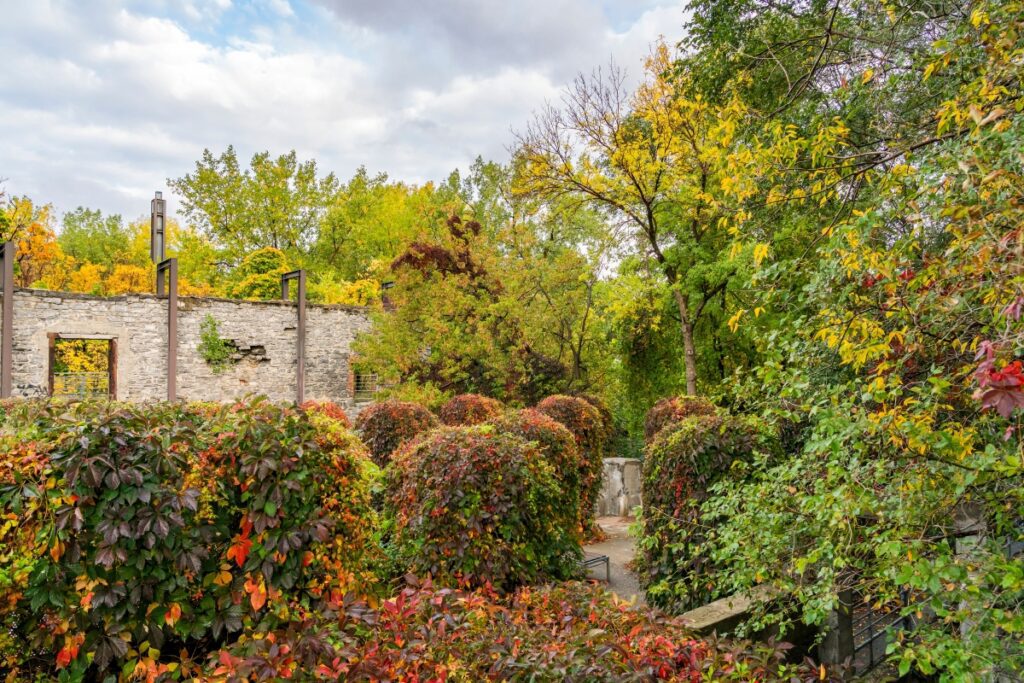
Place d’Armes was once a military parade ground and gathering space; the statue of Paul de Chomedey de Maisonneuve honours the city’s French founder. Many of the stone buildings you’ll see date to the 18th and 19th centuries, surviving fires and waves of urban renewal. Rue Notre-Dame, Place Jacques-Cartier, and the Old Port quays were once the heart of Montréal’s colonial trade—furs, timber, and goods shipped between Europe and the Americas.
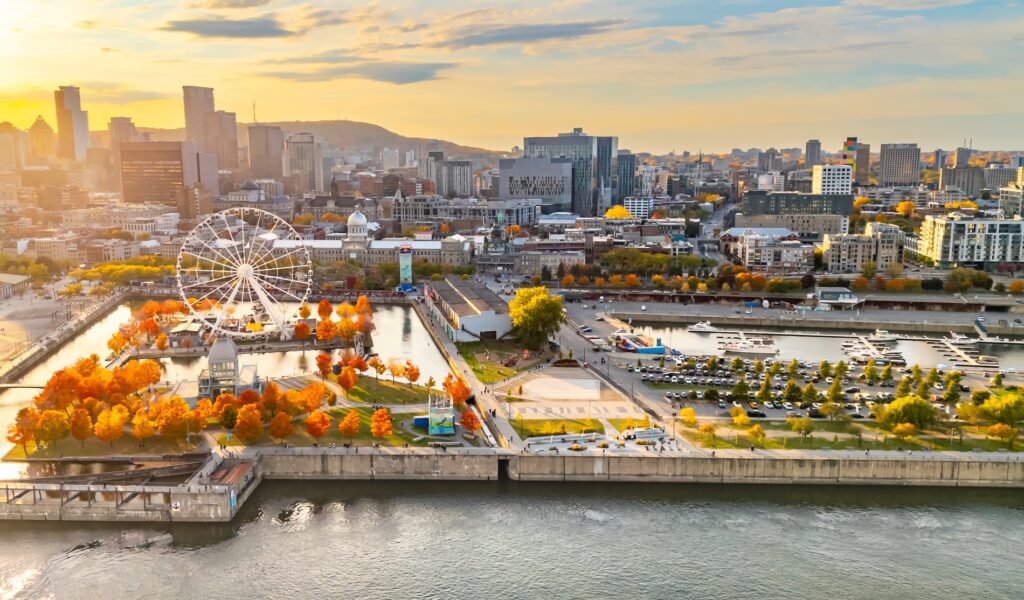
In fall, the golden leaves make these stones come alive—shadow and light play across centuries-old façades, and the river reflects both present-day bustle and the layered histories beneath it. The Old Port shines with autumn colour, especially around Bassin Bonsecours and beneath the Grande Roue. The trees along the waterfront promenade turn brilliant shades of yellow and red, framing postcard views of the ferris wheel, marina, and downtown skyline. For a panoramic burst of foliage and river views, walk out along the Grand Quai to the end of the pier—it’s one of the best fall vantage points in the city.
When to go
- Golden hour: Late afternoon brings saturated colour and fewer crowds.
- After dry spells: Leaves are brighter and trails less slippery 24+ hours after rain.
- Weekday mornings: Best for Mount Royal and the Canal.
What to bring
- Your camera!
- Light gloves, windproof layer, shoes with grip
- Reusable bottle; many parks have refill stations
- Small zip bag for your phone if showers are possible
Accessibility notes
Smoothest routes: La Fontaine Park perimeter, Lachine Canal paved sections, Parc Jean-Drapeau main lanes.
More uneven: Mount Royal trails. For strollers or wheelchairs, prioritize the Canal and Jean-Drapeau.
🍁 Did You Know?
- Mount Royal was once home to an observatory and even a ski slope — people used to toboggan down the hills by lamplight in the early 1900s.
- The Maison Smith on Mount Royal, near Beaver Lake, was originally a farmhouse built in 1858 and later became a lookout pavilion and café.
- Parc La Fontaine was Montréal’s first public park to host outdoor theatre in French. Its Théâtre de Verdure opened in 1956 and has welcomed artists ever since.
- The Lachine Canal was once so busy that it took over 3 hours for ships to pass due to traffic jams at the locks. It was the lifeblood of the city’s industrial economy for over 150 years.
- In the 1800s, Place Jacques-Cartier in Old Montréal was filled with fishmongers, butchers, and flower vendors—especially during fall harvest season.
- Jean-Drapeau Park’s islands were partially built using earth excavated from the Montréal metro system during its construction in the 1960s.
- Île-de-la-Visitation’s historic mill produced flour for over 200 years and supplied bread to early Montrealers, religious communities, and even military garrisons.
- Parc Maisonneuve once held one of the city’s largest sports arenas and horse racing tracks — it’s now one of the most peaceful green spaces for fall walks in the east end.
- The Biosphère at Parc Jean-Drapeau was designed by Buckminster Fuller and used to be enclosed in acrylic panels, which caught fire in 1976 — today only the steel dome remains.
Book a guide
Want the lookouts and the legends? Our licensed guides lead intimate, small-group person tours year-round.
- Explore Old Montréal (2 hours) – the perfect first-timer intro (max 10 people.
- RESO Underground City + Downtown – ideal if it’s chilly or raining (max 12 people).
FAQ
When do Montréal fall colours usually peak?
In the city, early to mid-October is typical. Sheltered parks and riversides can hold colour a little longer.
Where are the best skyline views with foliage?
Belvedere Kondiaronk on Mount Royal and the river edges of Parc Jean-Drapeau.
Can I do these routes without a car?
Yes. Every walk above starts near a métro station or frequent bus line.
What if it rains?
Save Mount Royal for a clear window and consider our Underground City route for a cozy alternative.
About MTL Detours
MTL Detours is a locally owned and operated tour company offering intimate, story-rich walking tours led by passionate, professional guides. With a focus on Montréal’s character, history, and hidden gems, our small-group experiences go beyond the postcard version of the city to reveal what makes it truly unforgettable.